

Health has always been claimed to be a noble profession; aimed at serving the mankind. Understanding human-complex psychosomatic organization is a treacherous task. However, tracking it down to a smooth operating system whenever there is an issue is what a health professional do. And this is likely one of the reasons why the health profession offers a continually expanding field, driven by the collective effort in serving patients, and ensuring the overall health of an individual.
With advancements in the field, no single physician, nurse, surgeon can fully manage a patient’s overall health on their own and is not a “one man job”. Health profession often is sub-divided based on type of diseases (oncologist, microbiologist), site of diseases (dentist, neurologist), type of treatment (radiologist, pathologist), organ with the diseases (endocrinologist, cardiologist) or broadly onto the age group of the patient (pediatrician, geriatrician); all dedicated for diagnostic precision and comprehensive management. Then come the professionals’ technicians, paramedical-laboratory technologists, radio technologists, public health experts, nurses etc., sometimes taken for granted who remains anonym with the ultimate goal of insuring the health of the patients.
If we recall 20-25 years back, the only health profession we seek for illness was called as “doctor” irrespective of their expertise in laboratory, radiography, nursing, dentistry or a dermatology. Every health care giver was respected under a unified umbrella of “doctor”. With the advancement in demand for health care, we have now plethora of specialization in the field; well-defined under various council. Following that, Nepal has Nepal Medical Council (2020), Nepal Health Research Council (2047), Nepal Nursing Council (2052), Nepal Heath Profession Council (2053), Nepal Pharmacy Council (2057)-as autonomous bodies. Government have embraced theses field in the health system of Nepal yet; its moral integration is still a big question.
Even though there is advancement and government acknowledgement in the field, due to lack of awareness, folks still can’t differentiate the roles carried by each health professionals. For example, even if you hold Ph.D. in medical laboratory technology and work in the core clinical pathology, you are designated as a stool-urine-sputum person. This might sound obscure, but COVID-19 has really favored the laboratory professional, which shifted the name tag of stool-urine-sputum person to life-savior.
The sub-specialties in health profession have expanded to an extent, that has even surpassed the knowledge of someone within the health profession. I remember a fellow general pathologist asking me,
“Is there something called an Oral Pathology” during my postgraduation periphery posting days. Well, I won’t take it as an offense, rather I would applaud the advancement of health sciences that gave the opportunity to explore various aspects of human health.
One thing that is widely celebrated in postgraduate matching for young doctors is, the field like surgery and medicine are always the first presence in counseling and anesthesia, microbiology, anatomy etc. probably the last list of preference. This shows disparity is not limited to inter-disciplinary fields, rather within the same discipline as well. We won’t miss to quote a prevailing concept among young aspirant from science background “I am preparing for MBBS; if not qualified, will chose BDS, even not qualified, will chose nursing, still not, then para-medics”- perceived inglorious hierarchy of healthcare careers. At worst this misconception strengthens further in the health academic institutions.
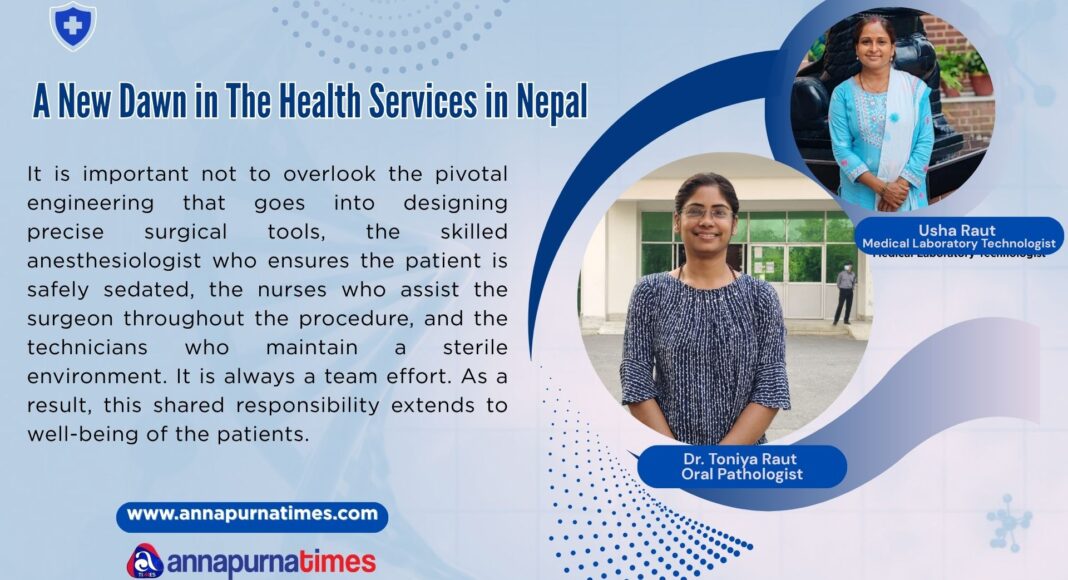
Undoubtedly, surgeons, neurologists or cardiologists are critical when a patient is either on the operating table, suffering from dementia, or experiencing cardiac arrest. However, it is important not to overlook the pivotal engineering that goes into designing precise surgical tools, the skilled anesthesiologist who ensures the patient is safely sedated, the nurses who assist the surgeon throughout the procedure, and the technicians who maintain a sterile environment. It is always a team effort. As a result, this shared responsibility extends to well-being of the patients. If one specialty were sufficient, we wouldn’t still have millions of people living with disorders and diseases without a cure. That’s where basic research comes into the picture: but that’s a discussion for another time. For now, in the present context of Nepal, it is long overdue that we celebrate and respect all healthcare workers.
The technicians, technologists, therapists, are the backbone of healthcare system who are often overlooked within the healthcare community and even by patients not intentionally, but through subtle and unconscious bias.
Let’s not get into moral policing, as there will always be logic to defend one’s perspective. However, awareness is gradually increasing within the public as well. It is encouraging to see that the general population now seeks dermatologists for skin conditions or pediatricians for their children’s health evaluations. We have even come across patients who proactively request ultrasonography, computed tomography scans, or blood tests to better understand their health status.
Appreciating this evolution, one question still strikes the mind is “if we have so many field specialists then why do we still lag behind to secure an optimal health status among general people?” one prime gap that we acknowledge over the period of time is that we have started treating the diseases not the diseased person. We lost our conscience and have started claiming our territory –
“Liver is my expertise; oral cavity is my expertise.
Heart is the major organ, so cardiologist is the best. Brain is the most vital so neurosurgeon is the best.
Surgery is risky so surgeon is the supreme”.
And in doing so we deliberately demean the importance of expertise in another field. Have we really forgot that Florence Nightingale is still remembered as a “Nurse”??
In health, saving life is not only supreme, providing quality life is equally important because a patient in coma has a life but not the one s/he is willing to have.
Health professionals should always be thoughtful about the fact that we were divided for comprehensive care of complex human body, serving the humanity as a whole not merely to treat an isolated illness. Human body is a system, not a delegation with one or few leaders.
While writing so, I want to share a story from my undergraduate days. One of our mentors, surgeon by training- a gem of the mentor. Every student either from MBBS, BDS or B.Sc. Nursing used to wait to have a discussion with him. This fondness of him was not because he is famous or someone with 100% success rate for surgery; rather because he explains every single case to every student around him irrespective of field, they belong to. That’s only because he was aware that every single field holds their own precise responsibilities, each contributing to making health good out of worst and best out of good.
At present, health has multifactorial influence and to conquer it, we must approach together and acknowledge. Division of health professional field was destined to achieve a good health and well-being of the patient rather than formulating hierarchy in the profession.
While saying so, we can’t stop writing about the recent post on appointment of our respectable Health minister, with a nursing background. With a predisposed biasedness, that only a doctor can handle a health system of a country, the appointment of present health minister is a breakthrough and awakening for such mindset. To be clear, formulating health policies, establishing standards, and ensuring the effective delivery of healthcare services, these are managerial responsibilities that have always been led and executed by nurses at every level of healthcare system.
Moreover, technical skills are not the criteria for the post of health minister but understanding and bringing solidarity among health technocrats, building a healthy nation is definitely a criterion to choose a health leader. And we all are looking forward to witness the historic transformation under present leadership in our health system which was once the glory for the nation.
To conclude, we truly believe it’s not about the profession rather than the person in the profession who can either disgrace the entire fraternity or stand strong and be the professional influencer. With that we request all our reader to hold and think, have we ever been a part of someone who have ever demean fellow on the basis of background of the profession? If “No” let’s applaud; if “Yes” let’s promise not to repeat that again.
PS we would like to thank Dr. Namrata G.R. Raut for her valuable inputs.
Usha Raut (Medical Laboratory Technologist) and Dr. Toniya Raut (Oral Pathologist).
